Tuesday, March 26, 2013

My Photo Book


Click here to view this photo book larger
Shutterfly photo books are the new way to preserve your memories. Create your own today.

Thursday, June 14, 2012

Simply Economical

While there has been much emphasis of late on the ideas of recycling, restoring, and re-using a lot of our "stuff" in the name of sustainability, sometimes it just happens naturally.   Especially here in the North Woods of Maine since the mill closures forced a lot of people in the area to use their creativity to sustain a livlihood.

Eight years ago when I bought my "camp" on South Twin Lake I discovered a need for few essential maintenance tools and pieces of equipment including a lawn mower.  The new friends I had made area pointed me in the direction of the supermarket bulletin boards and a couple of local guys who liked to fix stuff like mowers.  With very little effort I soon found and purchased a rather old mower in good running order for the sum of fifteen dollars cash.  I had half expected it to fail on the first or second use but to my surprise it performed well for the whole first summer I used it.  At the end of the season I put it away in one of my sheds and forgot about it until the following spring when the lawn needed to be cut.  Again, I had my doubts about the mower ever starting again, and again I was surprised when it burst into life on the first pull.  This cycle continued for another seven years so this year when for the first time it failed to start I was a little surprised.  I had come to depend on it's unfailing reliability.  

I pondered my small dilemma - should I pay to have a fifteen dollar mower fixed or just take it to the dump and get a new one.  It owed me nothing and paying $160 for a new one after seven years did not seem too bad an idea.  But then.... maybe I should give it one last chance before casting it off the the junk metal heap.  By now I had my list of "go to guys" for just about everything.  I had my plummer, my construction guy, my garage mechanic, and the guy who fixed my boat, all of whom could be depended upon to do whatever it took to get something working again when it failed.   My "boat guy" had really surprised me when the transom on my old 1985 Crestliner cracked and began to come adrift from the rest of the boat.  I was ready to call it quits with the boat but thought I'd take it to Lou anyway to take a look at it but feeling pretty sure he would tell me that it was beyond repair.  He didn't.  Instead he said he could fix it for about four hundred bucks which would include a reinforcing the transom with steel plates and caulking all the cracks.  I invested in his belief and today the boat is still running serving it's purpose.

So I threw the lawn mower in the back of my truck and took it in to town for Lou to see what he thought.  Lou has the reputation of being able to fix just about anything that has an engine, that floats, or that travels on snow.   And sure enough, Lou said he could fix the mower.  "Just leave it here and come back tomorrow" was about all he had to say.  So I did.  He cleaned out the carburettor and rebuilt it and put in a new filter and the old mower was back to starting on first pull again.  The cost - forty bucks.  As I drove home with the mower I couldn't help but smile knowing that I'd clearly done my part to keep equipment working instead of trashing it.  The fact is that people around here do it for one simple reason - it makes a lot of economic sense.  Not only that it serves the local economy.  People like Lou have a purpose and an income.  People like me save money and get stuff working again.  Its simply economical.

Wednesday, May 30, 2012

Fly, Fish, Feast!

Why would you fly for four hours, drive for three, hike for another three, just to fish for one hour?   For me this past weekend,  the answer is clear - a good catch of native brook trout.

First though, lets clear up some misconceptions.  Native brook trout found in northern Maine are not "trout" like you think of trout.  In fact they are a salmonoid with reddish colored flesh, a legacy of the last ice age.  They are closely related to arctic char but are much much smaller, sweeter, and ever more succulent.  The first time you taste one you will immediately recognize the difference.  These fish will only survive in pristine waters.  Pollution will kill them.  And no, in the ponds we fish, they are not stocked.  These fish spawn and engage their life cycle right there in the clear cold mountain pond fed by natural springs and snow melt. 

Heading to our secret pond last weekend (a lot of Mainers don't even tell their best friends where they fish), we hiked in to find the single campsite there occupied and the canoe that goes with it, spoken for by the campers.  After we chatted a while around their breakfast campfire, they generously offered us the use of the canoe until we got our bag limit.  From past experience that could take anything from  an hour to a full day but our campers assured us it would not take long today.

They were right.  We paddled to the middle of the pond and let the canoe drift down towards the end while we fished.  In Maine a pond is usually big enough to be called a lake in most other parts of the world, and this pond is like that.  It took us about an hour to drift from one end to the other and in that time we had nine fish.  Several small ones were released as it was clear from the outset that this was going to be a good day and fish of 10 to 12 inches (large for native brook trout in this area), were in abundance and easy to catch.   We paddled back a little to get one more fish and have our bag limit of 5 fish each.

We returned the canoe, hiked out to our truck, and got back to camp (aka "house on the lake") just after lunch.  This gave us the afternoon to relax, clean our catch, and prepare for our traditional evening feast of pan fried whole brook trout, fiddleheads, and potatoes accompanied by a bottle of Oyster Bay (NZ) Sauvignon Blanc.  Once more we had achieved what we had come for and toasted our success - fishing, friendship, and feasting on one of the most edible species of fish I've ever tasted.  Priceless!

Tuesday, May 29, 2012

A Most Memorable Meal

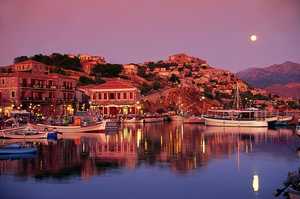
It was back in the early eighties. I was between jobs and had taken a year off from all work. One connection led to another and I found myself living on the Greek island of Lesvos in the village of Molivos.

 In those days, well before the Euro, it was a very inexpensive place to live and the lifestyle was just what I needed at the time. From early spring until late into the summer the climate was idyllic. It rarely rained, the wind rarely increased too much above a soft breeze, and the sun on the blue water of the Aegean Sea contrasting the many white buildings perched on the village hillside, made for a very relaxed and sensuous vibe. At night, at one of the three tavernas in the village, there was always good food and wine.

Dining out every night of the week didn’t seem to strain the budget in any way at all and was the main event of the day. I’d also leaned to speak and understand enough Greek to get by and enjoyed conversing with my new found Greek friends as well as the dozen or so long-term expats mostly from northern Europe. There were very few short term visitors in those days and the village life was as intriguing as the backdrop was appealing.

My daily routine was pretty simple. I would sleep until I was awakened by the smell of fresh pastries coming from the village bakery just below the window of my little two story Turkish style house. After a pastry or cheese pie from the bakery with a glass of water and a couple of cups of Greek coffee it would be time to head for one of the nearby beaches. My favorite was Eftalou about 4 kilometers away, and with the whole day at my disposal, it was a pleasant walk. If anyone passed in a vehicle on the narrow one lane dirt road they would always offer a ride.

On one such day at Eftalou I found myself in conversation John and Arianna. John came from England and although he’d lived in the village for several years spoke very little Greek. His friend Arianna came from Athens and probably because of her education and wealth had more in common with the foreigners than the local Greeks and was of great help to John as an interpreter and mouthpiece. A little later we were joined by Heinz who was a house painter from Munich who came to Molivos between jobs and had a residence there. He was a master of simple living and could often be found walking among the rocks with a hand spear looking for an octopus for dinner. Eating was important to Heinz and he was often a great resource in that department.

“Hey, you all want to join me for lunch?” he asked.
It was already past noon, none of us had brought food with us, and we were thinking of heading back to the village.
“Where?” asked John.
“Have you been to the little outdoor taverna down towards Skala Skimania out on the point?” asked Heinz.
None of us had.
“How do we get there, Heinz?” asked Arianna.
“We can walk along the beach and there is a road near the beach further along. It’s probably 4 or 5 kilometers.”
“Sounds too far for my legs” said John.
With a little urging John soon gave way and we were all strolling down the beach. An hour later we were sitting at one of two outdoor tables next to a small shack that served as a kitchen next to an outdoor fire pit that made up the complete taverna. Janni, the owner,  greeted us as profusely. A jug of cold local retsina was placed on the table as we sat and admired the view.

We were surrounded by the sea on three sides and across a small bay could see a small fishing village. The coast of Turkey was clearly visible some twelve kilometers across to the East. Two umbrellas in the blue and white colors of the Greek flag shaded the long table and much of our bodies from the strong rays of the early afternoon sun. A small ginger cat fed on the scraps in a large fry pan beside the fire pit.

Janni asked if we were hungry. As each of us responded in some way he took mental notes of how much food he might need to prepare. There was no menu. Janni and his wife would decide what to bring to the table, when to bring it, and in what quantity. This was not new to me and was a custom practiced in several of the smaller tavernas on the island. Heinz who had been here before asked Janni if he had any “marides” to start with. A smile and a head gesture from Janni told us he had some. “Marides” are small fish something similar to what many of us might know as smelts although they taste so much better. The Greeks roll them in flour and fry them whole in virgin olive oil.

Janni’s wife came out the fire pit, shooed away the cat, picked up the large frying pan and banged it twice on a nearby rock before placing it over the grate on the fire pit and pouring oil into it. I looked at John who also noticed what was happening and who despite his three years on the island seemed to hold on to many of his English ways. He squirmed a little but then shrugged and chugged down half a glass of his retsina. Heinz and Arianna also noticed but were obviously unaffected. I looked at the cat, now in the distance. It appeared to be in good health and free of any lethal diseases so I raised my glass shouting “Iassos!” and downed some retsina too.

I’m not sure if it was the sun, the seascape, the company, or the retsina, but those marides were the best I’d ever tasted. And that was just the beginning of a most memorable meal.  A day I will remember as the one when I didn't really care that a cat had cleaned the frying pan before it was used to cook my meal.

Tuesday, September 16, 2008

A MOUNTAIN OF MY OWN

When I signed the trail register at the beginning of the Sentinel Mountain Trail at Kidney Pond, I noticed I was the only person so far signing out of that trail today. I wondered if it would stay that way.

It did. For the next four hours, the trail and the mountain were mine. I had hiked Sentinel several years ago and before I’d ever hiked Katahdin. It appealed to me then because of its relative ease compared to other mountains in Baxter State Park, according to the guide book. Little did I know that then that there are really no “easy” mountains in the Park. Even Sentinel at less than 2000ft, is a solid hour and half of hiking on the typical BSP trail of mostly roots and rocks. Sentinel is a little deceiving though.

The first few miles are not very steep. In fact there are some flat sections around Kidney Pond, some gentle ups, and also a few downs near a couple of stream crossings. But like all large chunks of granite in the area with the name "mountain" attached, the last haul to the summit calls for a few pauses to breathe and to let a little heart pounding subside before continuing.

This time, I chose Sentinel because I wanted to see the view again and get some pictures from the summit. Sentinel gets its name from the fact that it stands like a sentinel in the south west corner, guarding the other mountains deeper into the Park. There was the usual morning fog which I’d assumed would burn off by the time I reached the top.

Realizing I had the mountain to myself gave rise to both excitement and a little trepidation. Hiking alone always adds a little more excitement to the adventure and knowing that nobody else was out there on the same trail added a little more. Some say you shouldn’t hike alone in the wilderness and I can understand that perspective, but don’t always choose to abide by it. Sure, you could have a heart attack, or fall and break your leg, or get attacked by a bear and no one would be there to help or to save you. To me it’s a simple matter of calculating the risks, managing them as well as possible, and enjoying the rewards that come from a little more risk exposure. Even though I’m no longer a spring chicken, as a pilot I’m required to have an annual physical. I’m told my heart health is pretty good for my age. Now if you are on heart medication, or are an overweight smoker, or have done no physical exercise in the past several months that you can recall, then yes, you’d better take a companion on your hike. As for bears, I figure that if a bear wants to eat someone, she’s just as likely to go for a menu of two as a menu of one. All a companion will achieve is to perhaps be first on the menu and give you a little extra time.

Now having said that partly in jest, I strongly believe the chances of being attacked by a bear in the Maine North Woods is pretty remote. I’ve seen several bears over the years and never once did I feel I was in danger. There are a few simple rules I follow that seem to work. Don’t get between a bear and her cub, and give the bear the room and time to move. Mostly they will amble off and leave the trail to you.

Given that the trails in the area are mostly rocks and roots with the odd stream crossing and several muddy patches, you really do have to focus on where you put your feet to avoid injury. This is not the place to hike with your head up. Sounds simple enough, but a friend who works in triage at the local hospital tells me that most falls on the trail happen because people simply don’t look where they are placing their feet. When asked how it happened the reply often includes “I was looking at ..(a bird, the trees, the trail up ahead, my brother coming behind me……) and I didn’t see the (rock or root) and I fell.” I’ve done enough rock hopping in Maine to know that if I want to look around, I stop and look. When my feet are moving so are my eyes but not too far from where my feet are landing. There’s always the danger of slipping on slippery rocks too, but the most dangerous is wet feet landing on what appears to be a smooth dry rock. I’m always aware of how wet my boot soles might be and take extra precaution when I know they are wet.

I see a lot of newbie hikers trying to imitate the pros with their shiny new hiking poles. Let me tell you, unless you plan on doing some serious long distance hiking, you do not need hiking poles to day hike most of the mountains in Baxter State Park. If anything they are more of a hindrance and are totally useless on mountains like Katahdin. On the other hand they do make an excellent lightning rod when strapped to the back of your pack. But if you really want to get struck by lightning you might as well also put a sheet of aluminum foil inside the back of your pants. Then when you do get zapped you’ll cover five miles of that ten mile hike in a single heart beat. Forgive my Maine sense of humor that I've acquired from my friends at the local watering hole.

Jokes aside, a better alternative to poles is a single solid staff. My preference is a five foot length of birch sapling. It serves to steady my upper body when I need a little more support but leaves my other hand free to grab tree trunks or rocks as well. And as for lightning, people do get hit. The odds are in your favor but I still always check the forecast before I hike and make sure I get below tree line if there is a storm.

The most serious danger in my book, weather hiking alone or with others, is the risk of hypothermia. Several people over the years have fallen prey to this one. It’s important to stay hydrated and to carry more than enough water for your hike. You also need appropriate clothing. Avoid cottons and go for polyester which doesn’t cling to your body when wet and make you cold. Carry rain gear and some extra dry clothing. I always take at least an extra pair of socks, an extra shirt, and a flashlight, in a dry sack, just in case. The temperature on the tops of many mountains can be ten to fifteen degrees colder than at the bottom. If circumstances do arise that you’ll need to spend a night on the mountain, make sure you’ll survive it.

So much for the risks of hiking alone and how to manage them. What about the rewards? For me the best part of hiking alone is that I get to choose my own pace. I don’t have to play catch up, I don’t have to stop and wait, and I get to feel my stride and go at the pace that is just right for me. I noticed today on Sentinel that my pace varied. When my second wind kicked in, I felt that wonderful feeling of a surge coming into my pace. When I began to feel the strain of the final accent to the summit, I noticed myself slow and breathe more deeply to accommodate. They say that everyone hikes their own hike, regardless. To me it just seems easier when hiking alone. I also enjoy being with my own thoughts without interruption. Like anything, too much of this would probably not be a good thing. For most of us though, I’d guess we don’t get enough of it. For me, when hiking alone, I begin to actually notice what I’m thinking about. I become a witness to my own racing mind and get to see all the things that seem to come to the top of the tree. I guess this is a form of meditation in a crude sort of way. And it works like it too. After a while I see the speed of my mind beginning to slow and I start to become more present to each moment and more present to what is around me.

On this particular hike I began to notice the different varieties of mushrooms I encountered along the trail. Being alone, I could take the time to stop for a closer look if I wanted. I even took a few photos with my digital camera to show a mushroom savvy friend. I know there are basically three kinds of mushroom. There are those you can eat with your steak, there are those you feed to your enemies with their steak, and there are the kind that will provide an inexpensive trip without needing to leave home. I don’t trust myself to know the difference so when I hike and see mushrooms I look at them for their visual appeal and not their food potential. Perhaps if I learn a little more about them it could add a little more excitement to future hiking adventures. After all, I do like mushrooms with my steak.

I did stop to pick the blueberries though. Being the second week in August, and after an abundantly wet several weeks (some say too wet), it was a perfect season from Maine’s wild blueberries. Around the summit of Sentinel I discovered a huge patch of heavily laden bushes exposed to the southern sun. The only container I had was an empty water bottle which I quickly filled with blueberries. I then went about devouring as many berries and I could possibly load up on. This was lunch. Anything I’d brought in my pack could wait till later.

The clouds had lifted a little but not enough for a clear view of Katahdin and its surrounding ridges. I shot a few photos anyway and began my descent, slowly at first to let the blueberries settle. On the way down I noticed that slightly exhilarating feeling I sometimes get when I hike. Some say its endorphins kicking in. I don’t know what causes it but I do recognize it. It’s a feeling like “all is well with life and with the world around me”. When I feel it gives rise to a litany of appreciation. I’m grateful for my health, for my life and all I have, my wife and family, my friends, and this great place in Maine where I’m now so fortunate to be.

The distance passes quickly now and soon I find myself back close to the shore of Kidney Pond. I know I’m close as I see the sky through the trees and hear the sound of the loons on the pond. From the shore of Kidney Pond there is an awesome view across the water to Katahdin’s bulk planted firmly behind it. I love this view and even though I have several photographs of it, I pause to take yet another. As I sign out at the trail register, I add one more gratitude to my mental list. Thanks for giving this mountain to just me today.

Thursday, March 27, 2008

Calendoon

This story was told to me one of my colleagues when I was a school teacher in the Outback. It is supposedly a true story and reflects the unique sense of humor of the Aussie in the bush.

Calendoon
by Michael Lee

“My turn!” said Will grabbing the rifle from his brother Sean’s hand. He filled the clip with another half dozen rounds and took careful aim while resting the rifle barrel on the window frame of the Holden Ute – the Aussie equivalent of a GMC pickup truck. The sun shimmered off the red dirt of the burnt landscape in this arid part of the outback. The boys had been on a weekend jaunt from Brisbane, a city some three hundred miles distant on the coast, and a place from where most people had rarely ventured this far into the heart of their country.

“Who’d wanna go out there?” they’d say. “That’s just a place for sheep, abos, and ‘roos!”

Will and Sean, both in their late teens, had heard their Uncle talk about his experiences in the outback when he was a sheep drover in his younger days. “There’s more bloody kangaroos out there than you could poke a stick at!” he had told them. So they had saved some money for a few paydays, borrowed their uncles 222 semi-automatic rifle, and headed out for a weekend of ‘roo hunting. It had been a long drive - two hundred miles to the end of the sealed road and then another hundred on dirt roads. There was so little traffic that you could spot an oncoming vehicle some 10 or miles away by the cloud of dust on the horizon.

After driving all night they had seen a few ‘roos on the morning of their arrival and had gotten off a few shots but from much too far away to be able to exact a kill. As a result most of the remaining kangaroos within miles had heard the shots and taken off. They remembered though that Uncle George had told them they needed a spotlight and the dark of night to be able to get close enough to get off a head shot and take down a giant red.

“Geez, we’ll just have to kill some time till tonight, Will,” said Sean.
“Yeah, mate. Would be good if we could get some sleep but it’s too bloody hot to sleep out here. Hey, look at that sign!”

They had just crossed a grid on the road with barbed wire fence stretching away from it on either side – a property boundary. A large white sign with bold red letters announced the name of the property they were entering. “CALENDOON” read the sign, some 200 yards distant. Had the boys done some research they would have known they were entering one of the largest sheep and cattle properties in South-West Queensland. In this part of the world public roads went through private property and single properties half the size of the state of Vermont were not uncommon.

Sean had pulled over to the side of the dirt road and grabbed the rifle from behind the seat. He took careful aim and fired blasting a hole just off center in one of the “O”s in the sign. A few more shots and a few more well placed holes in the “O” resulted. Will took his turn and placed a shot inside of the second “O” and was about to fire off his second shot when the boys noticed a cloud of dust approaching. Earlier in the day they had stopped to greet and chat with the occupants of other passing vehicles so were not surprised when Charlie pulled up and got out. Charlie was typical “cockie” as landowners in the outback were known. Even though he had barely turned forty his skin was bronzed and wrinkled from the sun. On his head he wore the wide brimmed felt hat, his shirt was brown with the two large chest pockets, and he his shorts were trim and neatly supported with belt and buckle. He wore the elastic sided riding boots with socks rising a few inches higher on his ankles.

“Gidday!” he greeted. “How ya goin? Orright?”

“Yeah, mate. Orrright!” Sean replied.

“Doin’ a bit o’ shootin’ are yez?” enquired Charlie.

“Yeah. Just killin’ a bit of time till we can get amongst ‘em tonight,” said Will.

“Nice lookin’ rifle ya got there!” said Charlie.

“Yeah. It’s our uncle’s. A semi-automatic,” offered Sean.

“Mind if I take a shot with ‘er?” asked Charlie.

“No worries mate! Go for it,” said Will, passing the rifle though the window of their Ute.

Charlie held the weapon in his hands for a few seconds appreciating its beauty and the feel of the wood trim around the barrel. He glanced at the clip to see three rounds available and one in the chamber. With a flick of his wrist he turned the end of the barrel back the way it had come and in through the window of the ute towards its roof over the driver’s head. With his finger on the trigger he squeezed off four quick shots, blasting four holes through the roof of the ute.

Will catapulted back into his brother’s lap amid the smoke and smell of burnt roof lining and torn metal.

“What the hell are you doin’ you stupid bastard? That’s our ute!” he exclaimed.

Charlie threw the rifle into his lap, and smiled as he pointed toward the “O”’s in Calendoon. “Yeah. And that’s my sign!”

He turned climbed back into his vehicle and drove away with a wave of his hand accompanied by a friendly “Gidday!”

Thursday, January 3, 2008

Washing The Bird

First published in AOPA Pilot, (Dec 2006) the Aircraft Owners and Pilots Magazine with a circulation of over 400,000.

Washing the Bird
Soaping up flying memories
By Michael Lee

Washing an airplane is nothing like washing a car. You can't just take it to the drive-through and enjoy the thrill of soapy water squirting at your face behind the windshield, big roller brushes thrashing away, and the air dryer sweeping away the beads of water. Not only is this a job that has to be done by hand, but also most airplanes are a lot bigger than cars. They require special soaps and polishes that are kind to their aluminum skin, and they take a whole lot longer to wash. It can take all day if you are picky. I'm generally not.
I remember the kid who used to wash my airplane for me. If only he were still around. He had approached me one day at the airport and asked if he could wash my airplane, as he needed money for his flying lessons. "Sure," I said, "how much?"
He told me it would be 100 bucks.
"Wow! You must be either very good or very expensive," I recall saying to him at the time. This was back when avgas could still be bought for just more than a buck a gallon, not the four bucks or more a gallon it costs today, and an hour of flight training was around $45.
"I'm very careful and will do a good job," Tim politely informed me. And he did. It took him six hours and when he was finished Archer 53A hadn't looked so good in years. Tim would wash my airplane for me once or twice a year and always for the same price and with the same pleasing result. Sometimes I'd help out just for the heck of it, and marvel as I watched the way he focused on every move as he rubbed, squirted, polished, and buffed.
Mine wasn't the only airplane Tim washed. He built up a healthy clientele, paid for his flying lessons, and earned his private pilot certificate. Shortly afterward, he went off to an aviation college to become a professional pilot flying the big iron. Now he's a first officer for a major airline and probably no longer washes airplanes, although it wouldn't surprise me if one day at some hub airport I spotted Tim doing his preflight walk around a Boeing 737 with polishing cloth in hand. I missed him when he left and was never able to replace him. So the job came back to me. I was really no match for him, even though I'd studied his moves. A three-hour job is the best the airplane gets from me.
My mind wanders. It's too difficult to focus. I find myself thinking about other things — aviation things, to be sure — prompted by my proximity to my airplane, other airplanes, and the comings and goings at the not-so-busy little airport. When I'm washing my airplane, I'm feeding my passion for aviation, but not with the washing.
Today as I wash, I think of many things. Noticing the small chips in the paintwork on the tail, I'm reminded how they got there-a brush I had with some freezing rain on a flight last winter. How relieved I was to be able to escape the ice by finding warmer air above. There are some blackish bug remnants on the wing, and my mind goes back to a late-evening arrival in northern Maine in early summer and the black flies being thick enough to blur my visibility during landing.
My reverie is broken by the sound of engines. I watch a big twin-engine amphibious Grumman Goose whose pilot is practicing some takeoffs and landings. The beautiful, gray, ungainly bird struggles skyward with engines roaring, into the shimmering sunlight. I sigh in appreciation and bring my attention back to the bugs with the movement of soapy sponge on metal. For a few strokes I focus like Tim, but can't do it for long. Soon I'm recalling more wonderful moments from the past, moments that only being a pilot and owning an airplane could give me.
I recall the 7-year-old whose mom would bring her to the airport on weekends just to watch from the parking lot. One beautiful Sunday just like today, seeing them there as usual, I asked the youngster, "Would you like to go for a ride today?" The look on her face at that moment comes vividly back to me along with the sound of her hearty "Wow!" shortly afterward, as wheels left the ground and we were flying. I saw her mom in the backseat with tears of joy streaming down her face, watching as her daughter fulfilled a dream to fly. Just thinking about it now makes me smile. Sharing my passion in some ways far surpasses the act of engaging in it.
My sponge moves over the lights on the wing tips. In my mind's eye I see the lights blinking as I wing over New York City at 10,000 feet on a clear, crisp night in the fall, gazing at the lights ablaze below, spread out like a giant twinkling carpet. As I wipe the antennas under the belly I recall the feeling of having mastered the use of instruments they feed. How cool it is to experience the exhilaration and satisfaction of breaking out of a low overcast sky on an instrument approach just 300 feet above the end of the runway after spending hours surrounded by nothing but gray-to be guided to the runway solely by the navigation instruments with no visual reference to ground or horizon until the last few seconds of the flight. I revel for a moment in the trust, the training, and the patience it takes to pull that off.
The buffing is as complete as I want to make it, and I put the buckets, sponges, and cloths away. Three hours have passed quickly. My time with my thoughts has been enjoyable even if I haven't given the job at hand my undivided attention. The result probably wouldn't meet Tim's standards. I think about that some more and recall some other conversations I had with Tim. He was passionate too. But was his passion really about washing airplanes? In hindsight, I think not.
His conversation never revealed much excitement about flying here at this airport or about washing airplanes. But he talked a lot about airlines and Boeings and the Airbus, and the dream job he would have one day. His driving force was propelling him into the front seat of a jet and he would settle for nothing less. What is more, he knew what he needed to do to get there and he did it. My airplane was part of his ticket and he took very good care of that ticket. It was his passion to one day fly as a professional that gave him his focus. Washing my bird was an important steppingstone in Tim's overall flight plan, and so he gave it the same focus he would when he stepped into that jet. There was a mission to accomplish. Time spent remembering could wait. Buffing my airplane to perfection would help buy those future days that would fuel his memories. I hope he's somewhere up there right now building them.
I chuckle to myself as I come to the tentative conclusion that my difficulty in washing the bird comes not from my dislike of the job itself, nor does it come from my difficulty in focusing. When I'm shooting an approach in ugly weather or landing in a 20-knot crosswind I am very focused.
My airplane-washing mind drift comes simply because I am fortunate enough to have accumulated such great memories from aviation. I'm free to choose not to focus on earthly pursuits when I'm around airplanes. I can allow my thoughts to take over to fuel my passion and take me away from the task. I have nothing to lose by allowing it. Yet when I'm flying I can switch in an instant and become completely focused to the task at hand — even getting ahead of the airplane to be ready for what happens next. It's really just a choice for me to indulge my memories and be the half-hearted airplane washer I seem to be. After all, how could I enjoy washing my bird if it wasn't for the happy-memory logbook in my mind? Yet three hours are long enough to indulge it, no matter how good the memories. I head for home. Mission accomplished.
Michael Lee, AOPA 1153628, is an Australian-born freelance writer and private pilot who owns a 1979 Piper Archer.


Fishing for Brookies

Unedited and unpublished but plan to work on it.

by Michael Lee

He leapt out from behind a tree along the trail like cat pouncing on his prey. “Warden Walter Wishoneke” read the name badge on his soaking wet uniform. We were his prey - three very tired and very wet fishermen about a mile into the long three mile hike back to the road after our day of fishing in an isolated pristine pond in the North Woods of Maine.

“OK boys,” said Game Warden Wally, “open your creels and get out your fishing licenses!” The surprise on our faces surely showed and he grinned and added, “Kind of wet day to be fishing isn’t it?”

It surely was. It had started raining on our hike in early in the morning. I had been looking forward to this day. In my three years of fishing in this part of Maine the native brook trout had eluded me. I wasn’t a fly fisherman which limited the number of places I could legally fish for ‘brookies’. I had met Sam and Jeff some time back on a chat forum about fishing in Maine. They both used to live in a small town some 30 miles north of my place in Maine and were returning for a weekend of fishing. They planned to hike in to this remote pond that they used to successfully fish as kids and teenagers growing up in this wild and beautiful part of the state. Although the weather had somewhat dampened my spirits after we met at the gas station in their town, I was reinspired by Sam’s assurance that “This is great weather for catching brookies.”

By the time we got to the pond we were all very well soaked. Although we wore rain gear the rain was so heavy at times the water found its way in. Our boots were no match for the puddles and small streams we trudged through. With the rain came strong gusty winds and even with the temperature around seventy, our wet bodies braced for the chill of each gust. We made it to the pond, assembled our poles, baited our hooks and began to fish. I had a strike almost immediately and hauled in the first fish for the day – a six inch brookie. I was about to throw it back when Jeff reminded me that it was at the legal limit to keep and the small one’s tasted great. Into my creel he went but I hoped to land some bigger ones. We moved spots a few times over the next hour to try to find the bigger ones. Finally we hit the right spots – places along the lake shore where small streams fed by the morning rains were flowing in. With the flow of water came tasty grubs and insects that the brookies came looking for. Our worms must have been additionally attractive as we began to catch some beautiful eight to ten inch trout. We spread out a little so as not to cramp each other and so didn’t really know what each was catching other than we were all fully engaged in baiting worms, removing trout from hooks, and becoming oblivious to the persistent rain and chill winds blowing across the water. The hours passed and being more selective now, I released many smaller fish, keeping only those that came in at ten inches or more.

My mind wandered to the descriptions I had read of these beautiful fish we were catching. This particular variety of trout is a true native – not a stocked variety. This was its natural habitat and thanks to careful management and the remote location it has survived and even thrived to the extent that fishing with worms is permitted here. Most other ponds in the area allow fly fishing only. I wasn’t sure if it was the weather or the strenuous hike but we were the only ones here on this day. By early afternoon we gathered and decided we had enough fish, each with our bag limit of five. Sam remarked however that even if we had cheated and taken a few more who would be out here on a day like this to check on us? He imagined the game wardens would all be snug in their cabin playing cards on a day like this. As Sam and Jeff ate the last of their lunch before the hike out, I allowed myself one final cast. I immediately felt a strong strike and carefully played the fish to shore. It was a lunker and looked to be bigger than any I had caught so far. My mind kicked in as I thought to myself, “I’m going to keep this one. Who cares if I have six fish in my creel instead of the five limit. Besides the first one I caught was barely legal size”. I was fishing this time from a rock a few feet above the pond. I brought my prize fish to the surface and decided that rather than try to lean over the rock and risk a plunge into the lake, I would hoist the fish up on to the rock. As I lifted it, I was once again in awe of its beauty and size. “He’ll have to go on the grill,” I muttered to myself. “Too big for the frying pan”. Just then the fish gave a flip of his tail and released himself from the hook with a splash and disappeared from sight.

Now standing in front of Warden Wally with my open creel, I thought again about that fish. “Thank you, fish” I thought. “If I had landed you, I would be in big trouble right now.” Wally checked our creels and licenses one by one. He looked a little skeptically at my first fish and I thought he would probably bring out his measure to check him, but he didn’t. We all seemed to pass muster, each with the bag limit of five and current Maine fishing licenses. He decided to hike the last two miles out with us and became quite jovial about the miserable day and lack of fishermen for him to check. Even when we reached our truck he hung out for a bit to chat some more. Eventually he departed and we began to change into some dry clothes we had left in the truck.

Sam also took off his wet boots and pulled down his socks. Our eyes popped as four more brookies, two from each sock, fell to the ground. “Damn,” I laughed, “Seems I have a lot more to learn from you local guys about fishing for brookies.”

Going Greek

Every year, usually in the early part of spring, I get this urge to “go Greek”. My Greek Day is often inspired by a combination of the color and the weather sometimes experienced in our New England Spring – a clear blue sky, the feeling of warmth when standing in sun, an increasing intensity of light, and the calmness that comes with little or no wind, and a fresh and shiny look to just about everything outdoors. This combination of conditions tends to take me back to the time I lived for the best part of a year on the Greek island of Lesvos.

“I need a time out!” I remember saying to my friends. “I need to get away where I can do nothing for a while.” Work and family life had been intense for a few years and I was also going through that mid-life questioning as to what really mattered in life. Through some connections I discovered the village of Molivos. With the help of my connection's friend who lived there I rented a house for six months for not a whole lot of drachma, bought tickets, took a crash course in Greek at the local community college, and then headed for the land of Helen and Hercules.

While that was then and this is now and I no longer have the urge to drop it all and head for the Greek islands, I do seem to get that pang of nostalgia every spring and it must be fed. This year I was ready for it. Before the urge hit I noticed a set of outdoor furniture on sale at the local hardware store. It was perfect. A blue sun umbrella with table and four chairs with blue and white stripes. A perfect likeness to the Greek flag. Just what I needed to prepare for my poolside Greek experience and I already had the grill.

Outdoor cooking over a charcoal grill was how most of the tavernas I had frequented in Greece did it. My favorite was surrounded by ocean on three sides.  The relaxed atmosphere, the great food, the stunning light, and the good wine did it. Who could worry about anything much while lazing under an umbrella by the ocean and enjoying a four hour lunch?

Photos of George's Fish Taverna, Petra
Taverna by the Sea
This photo of George's Fish Taverna is courtesy of TripAdvisor

It was early June this year when it happened. I was home for the day with no major commitments. The pool was open and I needed a day off.  Some cold beer, a chilled bottle of retsina, some octopus for the grill, and the ingredients for a real Greek salad, and all was set.

The grill was fired, some twangy bouzouki music blasted from the stereo, and the cooler was reachable beside the blue and white chairs where I sat, wearing only a swimsuit and sunglasses to soak up the sun and to eat and drink to all that was good in life.  I moved slowly as I grilled the octopus and prepared the salad.  Time did not matter today, and grilled octopus takes about 45 minutes to make it tender anyway, but who cares?

Grilled Octpus
Not Greece but Pretending
In Greece I was often surprised how quickly a day of doing nothing could pass so quickly. On many days my walk to the beach,  a bare half mile from my house,  could take up to two or three hours. Mostly it was stopping for coffee with neighbors. “Iassou, Mikalis! Ti pinis? Kafé?” I had become a regular at two or three houses along the way to the beach and felt great about accepting the hospitality offered, despite an awareness of a growing addiction for the thick sweet dark liquid that was brewed in the little pots on the stove and known as coffee.  It bore no resemblance to anything I had previously called by that name. The only problem was that by the time I got to the beach I was buzzing,  and any chance of dozing in the sun was long gone. My “going Greek” day at home was different. No ‘kafe’.

The memories soon begin to float to awareness as I lazed in the sun beside the pool.  It had been a strange time – probably one of a few times in my life when I had surrendered to hedonism beyond balance. Days were full of nothing but eating, drinking, and loving. I could feel "Zorba the Greek" springing to life from within and nothing seemed to matter. The music drew me back to wild rides over mountainous roads to raucous celebrations in neighboring villages and nights of ouzo and the smoke filled haze in the tavernas. My understanding of Greek had grown to the point that I could hold conversations long into the night with my new Greek and European friends. The end agreement of such conversations were usually always the same - nothing really mattered. Live for the moment!  Do it now! My time in Greece had given me a look at freedom, nihilism, and existentialism,  although I really didn't know it all at the time.  It also gave me consequences - a volatile and disintegrating relationship, questions about my integrity, and a lot of work to do to find balance in my life again.

Today, I look back and ask.  "What did this particular chapter in my life teach me?"

I know full well that Zorba is a part of me, and he is alive and well.  I also know that he needs exercise from time to time, and that he needs to do it within context.  The context of my life today, my priorities, the people I love, the things I value and all of the commitments I want to keep.  It was great to find him then and give him room to express, however awkwardly -  a great teacher. And today he gives me yet another lesson.

Can I expect my children to learn from my journey?  Probably not.  Yet I can relax in knowing that who I am today is a product of who I was then, but not the same.  My children learn from both - me then and me now.  They take a little piece of my Zorba.  And I think they know how to handle him more like I do today - room to play but not overpower.  But they still have their own lessons to learn in life which are not the same as mine, and they will undoubtedly set up their life to learn them, just as I did.  "Iassou, Zorba!"

Duck

As yet unpublished work in progress. Please leave me a comment if you like it or have any suggestions or publication possiblities.


Mostly I look at them swimming by on the lake but sometimes I like to eat some. I’ve never hunted ducks so until now I’ve relied on the supermarket for my supply. Last Saturday on my ritual stroll through the supermarket for the weekly groceries I happened to spy a tasty looking piece of the said bird - “Maple Leaf Farms – Half Roasted Duck”. In its beautifully enticing red and cream package with seasoned duck showing through the cellophane window, the directions said “fully cooked” - just pop it in the oven for 25 minutes at 375 degrees and dinner is ready. “That would be great for Monday night when I’d be dining alone”, I thought.
On my way home from the supermarket I stopped by our local CSA Farm. “CSA” is intellegencia speak for “Community Supported Agriculture”. Our farm known as Farm Girl Farm sells shares each year for around 400 bucks which entitles the shareholder to pick up a “share” of produce once a week. This week with the tomatoes long gone and not much else left in the field as I drove in, I did not expect a whole lot, but I was wrong. Bunches of baby beets along with lots of greens and winter squash were amongst the pickings laid out on the farm table. Happy with my harvest my mind turned to Monday’s dinner. Duck with steamed beets and braised bok choy seemed like the right combination along with a bottle of Aussie Rutherglen Shiraz that I knew I had stashed away.
I don’t mind eating alone but I’m not the “hunt in the fridge for some crappy left over and hope for the best” kind of guy. For me eating alone means “dining alone” and the selection and preparation of the repast is a big part of the fun.
So the duck went in the oven as prescribed, the beets were trimmed and set to steam and the bok-choy was in the pan to braise with a little garlic, olive oil, and lemon juice. The wine was open , the table set, the candles lit, and I was ready to dine.
“Excellent choice of wine”, I remarked to myself as I took the first sip. The beets attracted the first bite and that too prompted the remark to self “Tasty beets!” The duck looked great and so a little portion of the leg was forked and brought to mouth. “MMmmm….. so, so.” Another bite not much better. It looked good but had no real flavor. The meat was also stringy even though seemingly moist. It wasn’t dry and the preparation directions were probably right on. But something was missing here. Try the greens. “Ah, yes! I love them!” Another sip of wine. “Goes well with the meal except for that damned duck!”, came the inner voice.
For a while I went back and forth trying each until deciding to forget the duck and just focus on the beets and greens and enjoy the wine. Always adept at making good from a bad situation, I took my time to relish those parts of the meal that grabbed my palate and forego the rest. But my thoughts went elsewhere.
“Our food supply is really fucked for those of us who can taste the difference” came one voice.
“Don’t be friggin’ snob!” came another.
“But I’m not! I just want to eat things I enjoy and that duck really sucked! It was not worth the six bucks I paid for it and I feel I was cheated.”

“You were!” said a third voice. “How do you think a company can make money today with the high cost of product not to mention the huge cost of distribution now that gas is more than three bucks a gallon. Something has to get compromised in all that if you want the convenience of buying duck in your supermarket. They probably try to do it well but with mass produced product to begin with and freezing it for a long shelf life, don’t you think you’d be sacrificing something in the way real taste? Like what the fuck were you expecting?”
“Ahh.. how about something like the taste of the bok choy or the beets?”
“Dreaming! Unless you want to grow your own ducks you idiot. Haha!”
I poured another glass of wine. Damn, the decision was made. Next year was going duck hunting for the very first time.

Neighbors

This story is a work in progress. If you know a place that might want to publish it, let me know and I'll do some more work on it.

Neighbors
By Michael Lee

I was sad to hear that my neighbors are gone. Dani had a stroke and was taken off to hospital. Hopefully he’ll recover. But he and Joyce won’t be at their camp on South Twin Lake where they’ve lived for last 50 years. They didn’t waste time after Dani’s stroke and sold the place to a guy from further down the lake.

They were there when I bought my lakeside camp next door some 4 years ago. Not only were they great neighbors but have provided me with a lot of inspiration for living fully into old age. I was also in awe of their simple and happy lifestyle. I was able to celebrate their eightieth birthdays with them and always enjoyed their company along with their families and friends. They chose to make their camp their home sometime in the fifties when Dani still worked at the mill. He retired at least a decade before it downsized some five years ago. He still gets a small pension payment and social security which gave them enough to get by on if they kept life simple – and they really did.

I miss their presence and it’s lonely ‘up at camp’ now without my familiar neighbors next door. Whenever I was there hardly a day would go by without us exchanging greetings and spending a little time in each others company. I recall one such day from last winter and the adventure which followed.

“Well what do you think, Mike?” calls Joyce as I stick my head out the door around seven in the morning after over a foot of heavy wet snow had fallen overnight. Joyce is already out shoveling around the door outside of their place. She’s in pretty good shape and could easily be taken for ten to twenty years younger. Dani had been hanging tough too although recently bothered by accidents and few health problems, all of which in typical Maine fashion, he made light of.

“I don’t know Joyce,” I respond. “We could get a few more inches before it’s all over but I think I’ll get started on the plowing.” Little does Joyce know that I’ve never driven a plow truck in my life before. The previous night I visited with them after I had arrived. I had planned to spend a few days getting my place ready for summer but hadn’t anticipated the late winter extending into mid-April. There was still two feet of ice on the lake and snow drifts a good fifteen feet high around my camp. The pipe from my well was still frozen and although I had heat from a propane heater, I had no water. I’d survived for a few days like this before and it was no big deal but I had not anticipated an overnight snow storm dumping this much snow. In conversation the night before, I learned that Dani had an accident back in late February getting pinned between his plow truck and another vehicle in our shared driveway. Luckily Joyce heard his screams for help even above the sound of her vacuum cleaner, was able to back the plow truck up to get him free and then wrap his bloody legs in towels and drive him in his truck ten miles into town and to the hospital. They stitched him up and sent him home and everything seemed to be OK until one of his wounds became severely infected through to the bone. He went back for surgery and then had a vacuum inserted in the wound to help it drain and heal. “Look at this damn thing they put on me!” he said with a grin as he lifted up the tube, red with his blood, and bared his leg to show me the device.
“Geez! That must have kept you laid up for a while?” I say thinking about how they could have dealt with a Maine winter out here in the middle of no-where with not even a permanent neighbor close by.

Like me most of their neighbors are seasonal residents and stay away when the 50 knot norwesterlies blow drifting snow across the frozen lake in temperatures in double digit negatives. Dani and Joyce heat their camp with a wood burning furnace and Dani cuts and hauls the six or seven chords they need for a winter all by himself. Luckily it’s always stored away “down cellar” long before the first snows. Joyce tells me that in the last storm another year round resident from about two miles up the road came and plowed them out but they are not sure if he’s coming again after this next storm. Joyce is concerned about how I will be able to get out if the driveway isn’t plowed. “Don’t worry about me,” I tell her, “but how can I help get it done?”
“Well if you can get that god damn son of a bitch truck of mine started you can plow us out,” says Dani.
“Sure… why don’t I see if she’ll start”.
Dani gives me starting instructions. The truck is about fifteen years old and over the years has been modified by Dani every time something on it needed “fixing”. I scrape the snow from the last storm off and hit the starter. With a reluctant and sluggish sound it gives a cough and the engine springs to life. I run it a few minutes and return to tell them all is well and in the morning I’ll “plow us out”.

My oldest son Chris has done some plowing so after I get back to my camp I give him a call. “Anything I need to know about snow plowing other than just driving it with the plow down and pushing the snow away?” I ask. He laughs when I tell him what I’m planning to do but gives me a few pointers anyway.

This morning I’m excited to begin and head for the truck. She starts again just like last night. By the time I’m ready to drop the plow and begin Dani appears from his place with tube and bag slung over his shoulder. He’s not there because he’s worried about how I’ll do. Just wanting to be part of it all and help out. He advises me not to drop the plow too low for the first run and I follow his advice. What I don’t know is that the truck has very bald tires and there is a good thick layer of ice beneath the heavy wet snow. The result is that the truck doesn’t move when I drop the clutch and there I sit, truck roaring, wheels spinning, and no forward progress. By this time Dani has a shovel in hand and is ready to dig around the wheels, tube and bag still slung over his shoulder. I dismount from the truck cab and race over to grab the shovel from him which he hands over with a little reluctance and a big grin and says “OK then”.

For the next two hours or so we follow a similar routine. A little plowing, a lot of digging and sanding around the wheels to get the truck moving. A break in the routine comes when I slide the truck into a snowbank and we have to do a lot of digging. By this time Dani has found another shovel and there is no taking that away from him. Joyce observes from a distance knowing better than I that it is useless to try to talk Dani into putting down the shovel. Next thing without saying anything he climbs into the cab and decides he’ll try a little plowing himself. I look at Joyce and she just smiles and shrugs. I admire his skill in knowing just how much to rev the engine before engaging the clutch and how he gets the truck moving before lowering the plow blade. He makes a great long run up the driveway giving me a look and see lesson on how it should be done but on the reverse stalls the truck on the road. It won’t restart. “Too damned hot, goddambed truck!” he mutters as he looks for jumper cables. I’m not sure how he plans to use them as it would seem impossible to get another vehicle anywhere near the disabled plow truck parked across the access road. Just then a neighbor and his wife come driving along the road and stop where I’m waiting by the truck. ”What the hell is Dani up to now?” asks the woman. I explain.
“That man! I tell you, he’s tougher than nails!”
I nod in agreement.

The neighbor uses his truck to jump start the plow truck and I get in and continue a few more runs up and down the driveway. By now we are down to dirt in patches and it’s easier to get traction. We’re almost done when this time I stall the truck and it won’t restart. Fortunately it’s at the bottom of the driveway. “Leave the friggin thing there!” says Dani. “We as good as done anyway.” Joyce agrees reminding Dani that the visiting nurse will be coming by in a little while to check his wounds. I’m not sure she’ll make it as the access road in from the main road is awful messy. “She’ll be here all right!” says Dani. Dani retires inside and I shovel a little more before retreating to my place for cup of coffee and the removal of clothing wet on the inside from sweat and on the outside from wet snow. I notice that it is ten-thirty. How time flies when you are having fun.

Fly By

This story was published in the Katahdin Press in 2006.

FLY BY

By Michael Lee

In the Abanaki language, Katahdin means “greatest mountain”. Legend has it that Pamola resides there. A half-man half beast, he may or may not let you enter his domain near the top of the mountain. He holds the power to send destruction your way in many forms including heat, ice, snow, rain, and wind if you are not to be welcomed there

These thoughts pass through my mind as I pull back the power on my Piper Archer for the descent into Millinocket Airport after a pleasant early evening flight. Landing straight in on Runway 34, I get the usual full frontal view of “the big K” in the near distance. Majestic and powerful she stands in the fading light. My frequent day hikes in Baxter State Park have included several lesser mountains but as yet I have not tackled this 5,267 foot beauty - the northern terminus of the Appalachian Trail.

Next morning with my weekend guests Carl, Erik, and Andrea, I set off on the AT from Katahdin Stream for the 5.2 mile ascent.

The early morning mist is clearing, there is barely a breath of wind, and the sun begins filtering through the canopy of coloring leaves above us. Excitement pushes us into a pace that is probably a little too fast but the hiking feels great. The hours pass and we approach the tree line along with one of the steepest parts of the climb. Surprised a little, I see two hikers coming down the steep rocks ahead.

“Ahh... you must have been up early to have been to the summit already”, I chirp in greeting.

“We didn’t make it!” says the woman in front. “This is not a hike, this is damn rock climbing. People could die up there!”

I am tempted to say “Madam, people DO die up there!” but censor myself.

They are disappointed and a trifle angry. I’m not sure at who or what. I want to console them but don’t. Everyone has to hike their own hike and when it comes to reaching the top of a mountain like Katahdin “some will, some won’t, and so what”.

“Well have a nice day and I hope you enjoy your hike down”, I offer, as we continue to climb, perhaps just a trifle more apprehensively now from the reminder that death is in the realm of possibility for those entering Pamola’s domain.

But Pamola must have been having a good day. My apprehension is soon lifted by the sound of laughter coming from behind us. Three male hikers having a lot of fun quickly catch up to us. What a surprise to see two of the three dressed in kilts. By the look of the legs under the kilts it is also apparent that these guys have done some serious hiking. They give us a cheerful greeting and stop to chat for a minute.

This is their big day. The last 5.2 miles of their Appalachian Trail hike from Springer Mountain in Georgia to the summit of Katahdin. They introduce themselves by their trail names - Domino, Stilts, and Treetops. For a moment I wish I had a trail name too. My 13 year old son Jack and I had often joked about what our trail names might be if we had them – Jackie Legs and Maine E. Ack maybe? But we couldn’t name ourselves. We had to wait until a “real” hiker bestowed a name upon us. The three guys pose for a picture for one of my friends and then off they go. “See you at the top! On On!!” cheers Domino as they quickly disappear from our sight.

Even with this burst of inspiration, it takes us another two hours to make our own ascent. As we come up the final climb to the summit there are our three new acquaintances on their way down. They have spent an hour or more up there celebrating and we have missed the party. I ask what they plan to do when they get down now that they have finished the AT. “Go to town!” was the quick reply.
“Need a ride?” I offer.
“Sure, if we don’t get one before you finish we’ll look out for you,” said Stilts.

“Damn, of course!” I think to myself. We would be hours behind them and dressed in those kilts there was no way someone wouldn’t offer them a lift long before we got down. We congratulate them on their great accomplishment and set off to achieve our own. There is a brisk wind at the summit, but it isn’t too cold and the vista is awesome. In every direction we can see a hundred miles or more. In close up clarity are the infamous Knife Edge and The Chimney. The beauty of the peaks in Baxter Park to the north and west of Katahdin prompt me to make a mental note to put them on my list for future hikes. To the south is the chain of lakes with which I am familiar. I point out to my friends the island in South Twin Lake in front of my “camp” where we are staying. As a pilot I’ve had some great views, but there is something special about the ones you earn with your legs, one step at a time.

Unlike other mountains I have hiked, with Katahdin there is that awful feeling of anticipation about the long hike down. No leisurely stroll down on this mountain. A little more fear grips your body as you descend the steep inclines covered with huge rocks and try to find just the right place to plant your feet and avoid a costly fall. No one wants to have to be carried off the mountain even if it were possible

For us, the long hike down takes almost the same time as the ascent – partly because of the difficulty and our tiredness but also because we stop frequently to take in yet again the beautiful views continually unfolding before us. Weary, but exhilarated, we make it back to our truck about 10 hours after we had started. It is now our turn to sit, eat, and celebrate.

As we place our order at the Scootic Inn, a young guy comes over to our table and says, “Thanks for the offer of the ride up on the mountain today.” It’s Domino. At first I don’t recognize him. Minus the kilt, with hair washed and brushed, and clean shirt and pants, he doesn’t look much like, or even smell like, the thru hiker we had seen earlier in the day. It sure is great to see him again. I have a deep appreciation of thru hikers and am fascinated by their dedication, courage, and commitment. I’m also curious about what they must learn in six months on the trail, particularly about themselves. I want to talk more with Domino but he has friends to be with and a celebration to enjoy so I simply ask “Where to from here, now it’s over?”

He tells me that he and Stilts are planning to head to Hanover, New Hampshire for an AT Gathering while Treetops is heading south to hike some more of the southbound trail in warmer weather.

“Mmm... New Hampshire?” I offer. “Maybe I could give you guys a ride as I’m heading that way in my plane.”

I can tell that my last word has made an impact. I don’t think Domino is quite sure he can believe or trust what he is hearing me say, but after chatting a few more minutes he and Stilts know it was for real and accept what they say is their “ultimate hitch”.

Monday dawns. Another brilliant Maine weather day – perfect for flying. Around ten I pick up Domino and Stilts in Millinocket and we head to the airport. We stow their gear, do our preflight and are soon airborne. I decide to begin our flight with a close up look at Katahdin. How magnificent she looks on this beautiful morning. Knowing of my experience hiking up on Saturday, I can only imagine what it must have been like for my two passengers to have also climbed Katahdin that day but at the end of their very long hike. I believe I detect a slight moistening in their eyes as they look at the mountain and back at each other in amazement and awe. Then they get out their cameras and click away at Maine’s greatest.

Once again Pamola must be been doing some work for us but this time with the Air Traffic Control Gods. As luck would have it, neither of the two large military operations areas that cover much of Western Maine is active today. This means we can “fly the trail” at low altitude. For the next hour or so we fly over the 100 mile wilderness, Gulf Hagas, The Bigelows, Old Speck and numerous other mountains along the trail as well as the towns of Monson, Caratunk, Stratton and Rangeley - trail towns they have visited for rest and re-supply. For Stilts and Domino each vista holds memories and stories, too numerous to tell in this short time. As we pass Baldplate Mountain I hear them chuckle as they recall the French Canadian hikers they met and befriended there. It is obvious that what they are seeing is taking them back to many days and nights they have experienced in their last few months on the trail in one of the biggest and most difficult states it traverses.

I tell them that we were doing a “fly by” not only of Katahdin, but of all the mountains in Maine on the AT, in honor of their accomplishment and explain that in military aviation a “fly by” is often granted to a returning flight crew after a difficult mission is completed. These two guys have most certainly completed a mission many may dream about but very few accomplish. All too soon it seems, we pass by Mt Washington from the Maine side, then cross into New Hampshire and land at Lebanon airport. After an exchange of email addresses, some profound thanks, and hugs, my friends mount their packs, bid farewell, and hike off the airport ramp.

That evening I tell Jack the story of our meeting and our flight. Also a hiker, a prospective pilot, and someone who hiked Katahdin with his brother earlier in the year, he listens with great interest and is clearly wishing he had been there. At the end of my story he says “Dad, you should have asked them to give you a Trail Name. Those guys are real hikers and they could have given you one.”

Well, I like Jack’s thinking and maybe it isn’t too late to ask. I zap off an email to Domino and Stilts to tell them about Jack’s suggestion and find out if they would have time to consider giving me a name..

Next day comes their reply. They have presided for two hours in the Dirty Cowboy Café in Hanover (clearly an appropriate establishment for a hiker naming event) to ponder and decide on a name for me. I am honored. After considering suggestions like Wingman, Birdman, Maine Man, Trail Flyer and many others they finally come up with the winner from their short list. From this day forth, I will forever be known on the Trail as “Fly By Mike.”
Thanks guys, and happy trails! I hope Pamola brings you back to Maine sometime soon.


Michael Lee is an author of two books and a freelance writer. He commutes between his homes in Maine and Massachusetts in his private airplane and loves to explore Maine from the air and on foot.

Busted

This story was published in 2007 in"The Story Garden 7: The Best of Scrawl" and ezine published by the on line writers' forum "Scrawl".

BUSTED by Michael Lee

The last thing I want to do this Sunday morning is get out of bed and drive to the nearby ski mountain. But I have a date with the manager and my fourteen-year-old son.
Yesterday I dropped him and Neighbor Kid off to ski for the day. It was cold and windy but they were excited. “Not too many New York kids will be here today – too cold,” says Neighbor Kid gleefully. They hate the crowded weekends at the mountain. The ticket prices go from $15 to $50 and the crowd goes from one lane of parked cars to a parking lot full and overflowing. “How do you know who is a New York kid and who is not?” asks curious Dad. Uproarious laughter from both juvenile passengers before My Kid explains.
“Well, Dad, that’s easy. They have ALL the gear. You know … the real expensive stuff. And they can’t ski for shit!” “Mmmm,” I notice myself wondering, “should I deliver my ‘don’t stereotype’ lecture or just laugh?” I laugh.
I ask Neighbor Kid who is two years younger than My Kid if he’s all set for the day. He doesn’t usually ski this mountain and doesn’t have a season pass. “Yep… I have plenty of money for my pass and lunch,” he says. So I drop them off, shove the truck into four wheel and gun it across the still mostly empty parking lot for a little fun slippin’ and slidin’ to let out a bit of the juvenile that has rubbed off on me during the ride, gleefully looking at the kids faces in the rear view as I wave goodbye.
That evening I’m sitting at my computer when My Kid gets dropped off at home. I overhear conversation in the kitchen with Mother. Something about ‘trouble at the mountain’. I strain to listen but give up, deciding I need to hear the whole story later. I don’t have to wait long as Mother comes right in to tell me.
Seems as though the prices for tickets were more than Neighbor Kid had allowed for. He didn’t have enough for a ticket. I knew I should have waited. Here I am doing wheelies in the parking lot while Neighbor Kid is in distress. Better not tell Mother about that.
My Kid though, being the creative genius he is, decides on a plan. He will go to the office and tell them he forgot his season pass. They will give him a ticket for the day which he will pass on to Neighbor Kid and they will then both be off and skiing. He puts his plan to action, it works like a charm, and away they go. Mistake happens when Neighbor Kid gets cold and wants to buy a face mask with the money he didn’t need to use for a ticket. He discovers that if he has a season pass he can get a 50% discount. Ever eager to help out one more time, My Kid gives him his pass. Smart sales clerk checks pass with photo ID and says,“You don’t look like him!” BUSTED! Manager summons both kids to office for interrogation and subsequent confession. His decision - show up here tomorrow with a parent or your season pass will be revoked for the rest of the year.
So here I am with Mother coming along as she thinks this is serious enough to need the presence of two parents. As always she’s right. This is a big day in the evolution of awareness in this young man we call our son. Manager meets and greets and brings us to his office. He asks My Kid to tell his story again which he does with great humility, honesty, and eye contact. (Seems he has taken my coaching well. I’m impressed. Look from mother says “Don’t be!” I hide it.) Manager explains seriousness of the crime. Theft. Charges could be pressed. My Kid might not be invited back on the property – ever. He then tells him to wait outside while he talks to the parents. Immediately Manager’s demeanor changes from pissed to light. He empathizes with us. Tells us about the crazy stuff he did as a kid to help us feel better. Then asks what might be the best fix. We could just pay the money for the pass but would that be a good idea? We don’t think so. Last thing I want is to buy My Kid out of trouble unless he’s on death row or something equally serious. And I don’t want him to get away with this. Previous night, Mother had an idea. “How about we ask them if he can work it off?” she had suggested. I like it and we propose it. Manager likes the idea too. He phones the lodge and talks to Boss Lady. She agrees. My Kid can work bussing tables in the lodge. “How about next weekend, Saturday and Sunday?” suggests Manager.“Sounds like a plan,” I say. I make mental note of the benefit of small town life. No hassles about insurance, workers comp., liability and all that crap. Let's just find a way that will work for everyone.
Manager calls My Kid back in.Demeanor changes back to serious. He tells him of decision and how this particular debt to society and the company will be paid and adds, “If the Supervisor in the lodge says you do a good job you can get your pass back but no skiing all this week. OK?"
My Kid nods and then says “Thanks”, with just a hint of gleeful humility. We leave and drive home mostly in silence. I think how lucky My Kid is to get busted and now get an opportunity to redeem himself. I glance at his face and can see he gets it too.

Monday, December 10, 2007

Katahdin again

Late Fall 2007

“Da-a-a-ad! Dad! Where are you? “
I stirred from my half asleep state wondering which of my offspring was calling my name. In seconds I realized both who it was and where I was. It had been hard to sleep anyway in Shelter #5 at the Chimney Pond Camground at the base of Katahdin, Maine’s highest mountain. My first born daughter, now a 35 year old mother, had hiked in the 3.2 miles with me in the afternoon and we were spending the night here to make our ascent of the big mountain a little easier next morning.
“Over here!” I tried to respond loudly enough for her to hear me but hopefully not loud enough to wake up the rest of the almost full campground. It was mid October and the last week before the camp would close for the season. The night had a fall chill to it and a gentle little rain was falling.
Last year I had hiked the mountain with my three son’s and my grandson (Keiron’s son). We had a photo now mounted on the living room wall as a memento of the occasion. Keiron had only been to Maine once before with me about the time I bought our “camp” there some four years ago. A few weeks earlier she had expressed an interest in hiking Katahdin with me – now an annual ritual for me and what was becoming a rite of passage for our family. How could my oldest be denied such an opportunity? And I needed company for my hike as well. So we made plans and here we were.
The 3.2 mile hike in to Chimney from our truck at Roaring Brook had been somewhat of a shock for Keiron. I guess I had told her it was “fairly flat – maybe a little uphill but with the usual roots and rocks that go with any trail inside Baxter State Park”. She soon discovered that it was indeed uphill, the rocks were bigger than expected, and the 35 pound pack she was carrying felt a lot heavier. But we made good time and after a few hours and made our destination , checked in with the ranger, set up our lean to for the night and had an early dinner of food we had pre-prepared and carried in with us. By 7pm there was little else to do but turn in for the night and get a good sleep. I had noticed Keiron did not roll out her sleeping mat when we had been setting up. She’d claimed that for “just one night” she didn’t think she’d need it and could save the extra weight of carrying it. I could tell from her stirring she was having a cold and restless night. She had ventured out to the outhouse and had become lost on the way back to our shelter unable to read the small signs with numbers on them at the corner of the trail to each shelter. But she heard my response and found her way back. Within a few minutes I had returned to a state of semi-sleep while I listened to her continued stirring until sleep took over.
Perhaps a few hours later I thought I heard the same calling…. “Daaaaad!” Was it déjà –vu, was it a dream, or was it Keiron out there again. It was her, once again lost on the way back from the outhouse. This time her call had a little more energy to it and I was sure our fellow campers had heard it as I had. Again I responded as quietly as I could, she heard me and once again found her home for the night. I began wondering what the lack of sleep might mean for us next day as we made our assult on the big K – a difficult climb with the best of conditions and preparation. I encouraged her to try to sleep. The rain had become softer I thought but then as I myself got up to pee I noticed small flakes of snow mixed with rain and sleet. Indeed it felt colder and so no surprise that the precipitation was semi-solid. And if it was snowing here at the base of the mountain I was certain the precipitation higher up would be snow for sure. Not only that the earlier rain would have frozen on any surface it had contacted and that would be all the large granite boulders we would be scaling in the morning. I managed to grab a few more hours of sleep and I think Keiron did too. At least she didn’t get lost again and so hopefully the whole camp got some sleep as well.
At daylight we brewed some coffee on our butane stove, munched on a variety of whole food grain breads that Keiron had brought as a treat for us both. I smiled as I felt the weight of my chunk of bread and made some comment about it being about as heavy as a sleeping mat. Keiron smiled and it was re-assuring to see she hadn’t lost her sense of humor as a result of her nocturnal ordeals. That was good because in past ascents of Katahdin, I had found a sense of humor almost a mandatory hiking companion. When confronted by a 10 foot vertical rock with a blaze upon it indicating “up and over is where the trail is”, it helps if you can laugh before figuring out how to scale it.
We checked in at the Rangers Cabin to check the weather report and tell him of our plans for the hike. “You realize there is going to be some snow and ice up there, “ he cautioned. “Be sure to watch your footing and take it slow.”
I told him our plan was to go up the mountain by way of the Cathedral trail and down the Saddle trail. He thought that was a good choice but and asked “Have you done Cathedral before?”
“Saddle yes, but Cathedral no!”
“No problem – Cathedral is a more aggressive climb but you both look like you can handle it.”
I wondered what he was thinking and how he might handle the situation when someone standing before him would most certainly not look like they could handle it. Would he say “Listen you fat ass there is no way you can make it up there!” Or would he choose a more politically correct turn of phrase.
Anyway it was reassuring to know we had passed muster on our looks. I wonder if he knew what I was thinking, having heard that Cathedral is one of the most challenging ascents to the summit going up some three thousand feet in less than two miles with much hand over hand bouldering and rock climbing. But no time for thinking now. We picked up our day packs with our several extra layers of clothing, more food than we would probably eat, and the mandatory two liters of water each. At least at this time of year we wouldn’t need any bug repellent.
The first half mile was a gentle ascent with the usual rock hopping. Then we began the big climb of the First Cathedral. The Cathedrals are so named for the three separate mini-peaks or spires that stand out of the side of the mountain. Each one is an almost vertical, hand over hand, rock climb. Blue blazes mark the trail and are placed in such a was as to supposedly indicate not only the safest route but also the most favorable. To me the people who mark the trail also have a sense of humor with blazes often painted in places that make you simply stop and declare “No f….g way! How am I supposed to go up THERE!” Usually with a little patience, trial and error, and creativity a way emerges and up you go.
I laughed when Keiron looked up at the summit of the First Cathedral and joyfully announced that we were almost at the summit. She couldn’t see the next two Cathedrals and the actual summit of the mountain even further behind that. We had barely reached a quarter of the distance to the summit. Soon we also began to see and feel snow and ice on the rocks we climbed. Luckily we had both brought gloves. I remember the first time I hiked Katahdin without gloves and ended the day with many small cuts on my hands from the sharp edges of rock. Now with the cold as well it was even more important to have covering for our hands. We had been so focused on our climb with our face to the wall that we hadn’t taken the time to enjoy the view behind us. It was only when we stopped to drink and turned around that we noticed and it was great to hear Keiron emit a grateful “Wow!” The view was even more awesome as we were sitting just under a cloud and would soon be plunging upward into it’s mist. The valley below was bathed in patches of sunlight coming through the clouds and lighting up the fall colors at full peak. It was indeed a good time to hiking Katahdin and I hoped at the summit we would be afforded a view but suspected we might be in cloud with only a few yards of visibility in any direction.
The second and third Cathedrals came and went and we found ourselves at that “almost” place. Every time I’ve hiked Katahdin I have noticed this deceptive “almost “ place. You think you are almost there. You can sometimes even see the summit. Yet between you and your destination remains some more arduous and challenging hiking. On this trail it was some more bouldering – steep bouldering – maybe even steeper than each of the Cathedrals behind us. At last we broke onto the tableland for the final fifth of a mile and through the mist could make out the infamous sign marking the summit and a handful of people milling around. It felt good to arrive and greet our fellow hikers. The mist rolled across the summit but every so often would clear and we would find ourselves sitting in sunlight looking out over the top of the cloud bank surrounding the summit on the North side. To the South it was totally fogged in with no view at all. I had hoped to see our camp and the island in front of it on South Twin lake, some 20 miles to the south, but today it was not to be.
As we broke open our lunch we could hear the cheers of a lone hiking ascending to the summit via the Appalaichan (Hunt) Trail. He immediately raced to the sign, kissed it, and declared “I made it. Now I’m just a bum again!” He went on to tell us that after completing his 2,174 mile hike from Georgia to Maine he was now no longer a “thru-hiker”. Now he was just a “bum” again. I could see the sense of his logic but couldn’t help reminding him that he was perhaps a “bum with a resume” as many may dream of hiking the AT but only about ten percent of those who start ever make it.
Several more finishing thru-hikers arrived as we ate our lunch and chatted amiably.
After a few photos to commemorate our ascent we began the hike down across the tableland and to the head of the Saddle Trail. This was a relatively easy descent or at least not too difficult when compared to other trails I’ve used to get off this big mountain. It was good to reach Chimney Pond but then we had to shoulder our packs for the final 3.5 miles. It was this last haul that challenged me the most but Keiron seemed to be loping along eager to be done and clearly wanting to make sure there was no possibility of us spending another night in a shelter.
We made it back to our truck and into Millinocket for a meal at the Scootic Inn before heading back to our “camp” for a long and comfortable sleep after a father-daughter adventure that neither of us will forget.

Sunday, September 16, 2007

SOUTH TURNER

South Turner Mountain is a special one to me. It happened to be the first mountain in Baxter State Park that I ever hiked and long before I ever considered hiking them all. It was also in some ways an ‘accidental’ hike. I was working on my previous book and enjoying some time with son Josh (16) and daughter Shannon (3). We had decided to drive up in the Park and go to Sandy Stream in the hope of seeing a moose. Sandy Stream was often a good place to find one and it was only a short hike from the parking area at Sandy Stream Campground.

Josh was eager for a hike. He loved the outdoors and earlier in the day had talked about wanting to hike Katahdin. Shannon loved the short hike to Sandy Pond and sure enough there were two moose grazing there. We had fun finding different spots around the pond to get a little closer to them. Josh was still wanting to hike.

“How about we hike South Turner, Dad?”

“What about Shannon?” I replied.

“I’ll carry her if she doesn’t want to walk”

“I want to go. I can walk. I’m a hiker girl” chimed in Shannon. We’d been telling her what a great ‘hiker girl’ she was on the short hike from the car park to the pond.

“OK,” I responded. “Here is the deal. We’ll hike a little way up the trail but if Shannon gets tired we turn around”

“We’ll make it, Dad!” says Josh.

“Yes, Dad, we’ll make it!” echoed Shannon.

The first part of the trail was fairly easy. There were some rocks but the going was relatively flat. When we started to ascend we came to the first boulder area. Josh was excited. With a little bit of help Shannon negotiated it well and so far did not want to be carried. It was only when the trail started to ascend more steeply that she asked for a ride. Josh willingly obliged and we even picked up the pace with him shouldering his little sibling. We continued to ascend with Shannon sometimes wanting to walk and sometimes wanting a carry. I carried for a while but knew it wasn’t something I wanted to do a lot. A 40 pound pack is one thing but a squirmy 40 pound three year old is another. But Josh was committed and didn’t seem to mind whenever Shannon wanted a ride.

Eventually we hit the tree line. This is when the fun began. The weather had been fine but there were low clouds hanging over most of the Park. We were now approaching them. They thin broken misty clouds that came and went. At times they obscured the summit but at other times we could see fairly well. I had to make a judgement call and be the parent regardless of what my fellow hikers said. Should we go back or press on. I paused to consider while we stopped for a drink. There were other hikers on the trail and its seemed like forward visibility was good enough to at least see the next blaze and the trail was well marked. The weather however was not the only factor. The last half mile of our climb was over big boulders and I mean BIG. Shannon had to be passed from one to another at times and when she was carried Josh needed to take extra care to not fall and hurt her and himself. I only had to caution him once and he became very focused. Again I decided it was OK to press on. We didn’t have far to go and there is that adrenaline rush that comes when approaching the summit of any mountain. Shannon, however, was starting to lose it. She didn’t like the clouds that from time to time blew in and surrounded us. She got very scared but then once the cloud was gone she would be fine. We were almost there so I cheered her on and told her that soon we’d be at the top and then we’d come back down to where there weren’t any clouds. Luckily, at that moment we also saw another family with two small children. Josh pointed them out and this gave Shannon a little more courage. We pressed on up the last few boulders and arrived at the top. What a treat to pause and look at the view which every so often revealed itself as the swirling mists separated. We hugged together for a few moments and celebrated our first peak together, then it was time to go.

Coming down was no easier then going up for the first part of the descent. We had to tread carefully and now some of the rocks had become wet from the passing mist. Shannon was tired and wanting more and more to be carried. Josh did most of it. I helped out from time to time. Looking at Josh carrying Shannon in front of me brought home to me how much he had matured. Not long ago he was Shannon’s size, Now he was becoming a strong young man. I admired his strength, his tenacity, and his willingness to make something happen if it meant carrying a bigger load. By now we were down on the easier going but still had a mile or more to go. I asked Josh how he was doing and although I could see he was beginning to slow a little, he claimed he was fine. I took over again for a while but for me now Shannon was a heavy load. My legs were getting tired from the descent – always much harder on my knees than going up. Josh took over for the remainder and we were in high spirits as we approached Sandy Stream and our truck in the car park. As we got ready to drive off, I noticed Josh’s legs. They were quivering. We both noticed and looked at each other and laughed. Shannon laughed too and declared…”See, aren’t I a good hiker girl?”